Effort vs. Complexity: Choosing the Right Estimation Metric for Your Team
By The Quely Team — Quely editorial team
The debate over how to estimate work in Agile is not going away anytime soon.
Search for “effort vs complexity estimation” and you’ll find some opinionated blog posts and Reddit threads. Some argue story points are all about effort. Others say they measure complexity. Most agree hours are bad but still use them. And too many articles repeat the same tired examples (licking 1,000 stamps vs. brain surgery) without actually helping you make decisions.
Here’s the thing: estimation isn't just a technical exercise. It’s a cultural signal. How your team estimates work can affect how safe developers feel, how well stakeholders plan, and whether sprint planning clarifies or causes confusion. That’s especially true for SaaS product teams juggling roadmap delivery, unplanned support issues, and ongoing customer improvements.
In this article, we bring together opinions from experts and practical tips to help you find the right estimation approach for your team whether you're early in your Agile journey or refining your process.
What Do Agile Experts Say About Estimation Metrics
Let’s step back and review what leading voices in Agile estimation actually advise, distilling their insights and identifying where they overlap.
1. Mike Cohn: The Case for Effort-Oriented Points
In Agile Estimating and Planning, Mike Cohn argues that story points are effort metrics bundling complexity, risk, and volume into a single relative measure. In his opinion, the real power of points is in their ability to reflect “how much work a team can accomplish” in a sprint. He illustrates this with a classic paradox: licking 1,000 stamps and performing a simple brain surgery might take equal time, yet their inherent difficulty is worlds apart. By assigning both activities the same point value when they require the same effort, teams learn to focus on capacity rather than just technical challenge.
Key takeaway: Points should mirror effort—not just complexity—so that velocity (points per sprint) remains a reliable gauge of team capacity.
2. The Complexity-First Viewpoint (From Eficode)
Eficode, one of Europe’s leading DevOps consultancies and a premier Atlassian partner advocates for a clearer, more disciplined use of story points in Agile teams. In their blog, they argue that many teams misuse story points by equating them to hours, which undermines the original intent of relative estimation. Story points, according to this view, should measure complexity, not time.
By tying estimates too closely to hours, teams reintroduce the very problems story points aim to solve: padding, missed deadlines, and a false sense of accuracy. Eficode’s guidance encourages teams to anchor their estimation in comparative analysis instead. A 5-point story should be viewed as roughly five times more complex than a 1-point task regardless of how many hours either takes to complete.
Key takeaway: Decouple points from time to preserve the integrity of relative sizing and foster honest risk conversations.
3. Estimation as an Evolving Practice (Thoughtworks’ Perspective)
After analyzing various Thoughtworks publications on Agile estimation, their stance is that estimation is not a one-size-fits-all practice, but an evolving discipline shaped by team maturity, organizational trust, and tooling sophistication.
In early stages, many teams rely on time-based estimates to gain confidence and communicate predictability. Over time, as teams accumulate sprint data and establish a sustainable velocity, they often transition to relative estimation models using story points or T-shirt sizes to reflect effort and complexity without being tied to clock hours.
At the most advanced end of the spectrum, Thoughtworks promotes the use of flow-based metrics like cycle time, throughput, and lead time. These metrics reflect actual delivery patterns and reduce reliance on speculative forecasting. The message is clear: mature teams can often shift away from formal estimation altogether and lean into real-time indicators of delivery health.
Key takeaway: Choose an estimation method that aligns with your team’s current maturity—and be prepared to evolve it as you grow.
Use Quely to Add Context to Estimation
Every team has its own estimation method. Quely does not make the metric the product; it connects the work to the decisions, discussions, constraints, and historical context the team needs to interpret that metric.
Keep the chosen method attached to the work: Execution objects enter a Space as Work Units while retaining the native properties used by the team. That keeps relative sizing or time forecasts connected to the work being discussed.
Bring ownership into the forecast: Ownership provides responsibility, current commitments, workload, and available capacity. Teams can use that context to test whether an effort forecast is plausible for the people expected to deliver it.
Surface uncertainty before choosing a number: Orbit reasons across Work Units and Context Units to surface questions, dependencies, risks, blockers, and assumptions as Signals. The team—not the system—owns the final estimate.
Quely helps make the reasoning behind an estimate visible and recoverable. It does not turn an uncertain forecast into a promise.
Should You Use Both Effort and Complexity When Estimating?
Some teams try a hybrid model: using story points for long-term planning and breaking work into hours for daily execution. You might be tempted to do the same—and in some cases, it works. But if you’re not careful, it can create more overhead than insight. The key is knowing why you're estimating and making sure each metric serves a distinct purpose.
You should ask yourself: Why are you estimating in the first place? If it’s just to align your team internally or start conversation, then whether you use effort or complexity doesn’t matter much. But if you need to plan capacity or report timelines to stakeholders, the distinction becomes critical.
Let’s say you’re trying to figure out how much your team can get done in a two-week sprint. In that case, time-based effort estimates might feel like a better fit, at least early on because they give you a direct way to map tasks to available time.
But if your team is a bit more mature and you’ve run several sprints, switching to complexity-based story points can give you a more flexible and scalable model. As your velocity becomes more stable, you can forecast delivery windows without obsessing over the hours.
Some teams combine both: story points to guide sprint or release planning, and hours to break down individual tasks for day-to-day work. That might work for you too. Just know it can be risky. Communities warn that dual tracking often causes confusion, adds busywork, or results in teams unintentionally “gaming” the numbers to satisfy two different systems.
If your stakeholders are pushing for both, that might actually be a trust issue. They may want the perceived certainty of hours over the abstraction of points. If that’s the case, your best move might be education, not estimation complexity.
If you do use a hybrid model, make sure each metric has a specific audience and purpose. Otherwise, you're just doubling your workload and watering down the value of both.
Effort vs. Complexity Estimation for SaaS Teams: How to Choose the Right Agile Metric
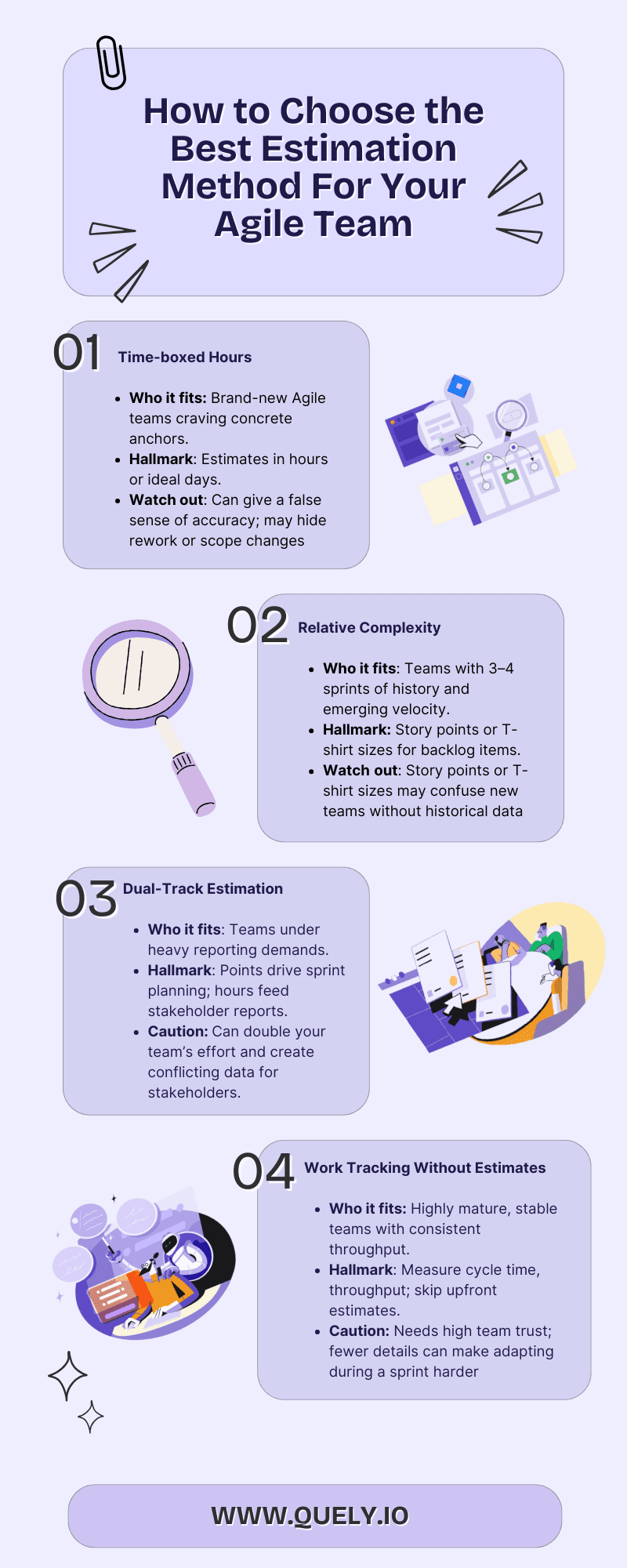
When you choose between effort-based or complexity-based estimation or a mix of both, your decision should come from insight about your team:
Team Maturity & Stability
New or growing teams often start with simple effort estimates (e.g. “Feature X is ~3 days of work”), because they lack velocity history and need concrete anchors.
Stable, mature teams with consistent sprint data benefit more from relative sizing (story points or T-shirt sizes), and may even experiment with #NoEstimates once throughput metrics are reliable .
Purpose of Estimation
If you’re focused on short-cycle capacity planning (ensuring the sprint isn’t overloaded), an effort metric that loosely correlates to time can be helpful—whether implicitly via story points or explicitly via ideal hours .
If you want to drive deeper implementation conversations and surface technical risk, complexity-first approaches (story points or T-shirt sizes) force teams to discuss unknowns and dependencies before coding.
Stakeholder & Leadership Expectations
In SaaS firms, product managers and executives often ask, “When will feature X be delivered?” If they demand hard dates, you may need to translate story-point velocity into time-based forecasts—but stress that velocity can fluctuate.
A common compromise is to use points internally for planning and publish a date range externally (e.g. “3–5 sprints”), rather than a single deadline .
Tooling & Process Fit
Many SaaS teams on Jira or similar ALM platforms gravitate toward story points because built-in velocity charts make progress visible.
If you’re more Kanban/DevOps-oriented, you might track cycle time and throughput, forgoing estimates entirely in favor of service-level targets (e.g. “80% of work items done within 3 days”).
When unplanned production issues are frequent, you can either reserve sprint buffer or size interrupts in small point buckets, so they count against your velocity without derailing planned stories .
Business Constraints
Contractual commitments or external client deadlines often push teams toward hours or “ideal days,” because they plug directly into project budgets. Some organizations maintain a dual estimate—points for internal agility, hours for client transparency—but beware of the extra overhead and potential inconsistencies .
If you operate entirely in-house with continuous delivery, you have more freedom to embrace abstract complexity sizing or even skip estimates, leaning on flow metrics to optimize delivery.
Additional Tips
Sprint planning with interruption reserves: Use recent support and incident history to reserve capacity for unplanned tickets. Track incoming work in consistent buckets so you can measure its effect and recalibrate the reserve.
Stakeholder-Friendly Reporting
Build a velocity dashboard showing average points per sprint, with high/low confidence bands. When asked for delivery dates, offer ranges—“Feature X will ship in 3–5 sprints”—and accompany charts with narrative bullet points on key risks or dependencies.Epic-Level T-Shirt Sizing
At quarterly roadmap sessions, size large initiatives with T-shirts (S, M, L, XL). As you approach implementation, decompose epics into stories and re-estimate them in points. After completion, compare actual effort to original T-shirt size to recalibrate your future sizing.
Conclusion
The success of your team hinges on how well you estimate and plan. Choosing the right metric, whether it’s based on effort or complexity can mean the difference between seamless project execution and frustrating bottlenecks. But it doesn't end at just picking a method; it’s having the tools to make your approach effective.
That’s where Quely can help: keep the selected metric connected to the work, surface the Signals that challenge it, and review Ownership before turning a forecast into a commitment.
Related reading: Review the practical guide to Agile estimation.